DIY Hydroponics and How To Get Started
by Kevin
Building your own DIY hydroponics growing systems from scratch is becoming an increasingly popular trend, so I've set out to determine why this happens and why the hydroponics gardening industry is gradually sucked in by the homemade phenomenon.
Building Your Own DIY Hydroponics
Building your own DIY hydroponics growing systems from scratch at Home!
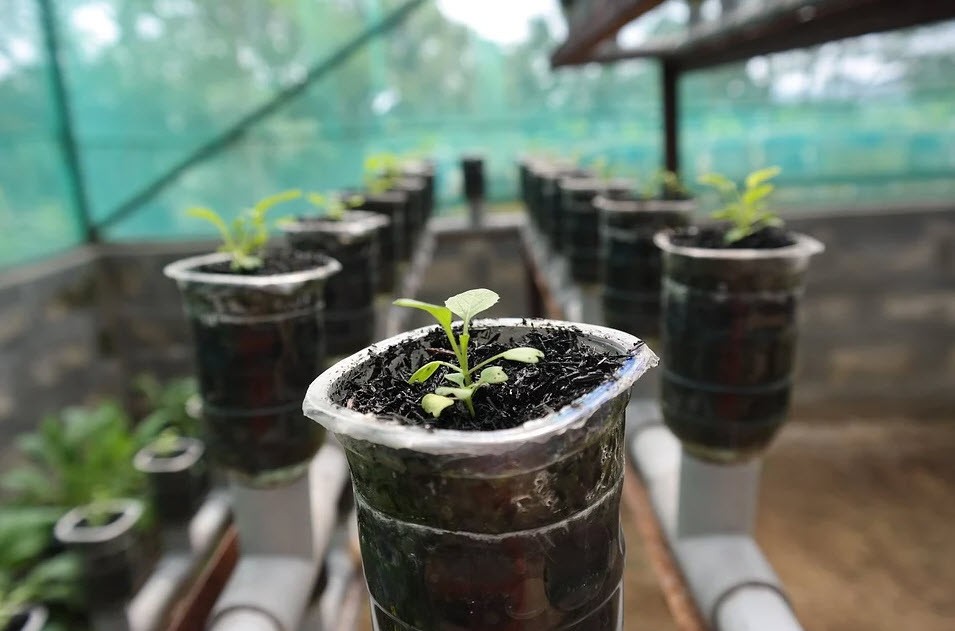
For a newcomer to the beautiful field of hydroponics, one of the first and toughest choices to go through will be that of the type of hydroponics growing systems to use: a homemade one or a ready-made branded product.
Obviously, each has their own benefits and disadvantages, but when you put them head to head is when you can really see what they're worth.
And seeing how it's an increasing trend to build your own homemade systems instead of buying them straight from the shop, I decided to make an analysis and see exactly why this happens and why homemade hydroponics growing systems are becoming the king of the hill.
A few decades back, when the Internet wasn't this big, or at least when hydroponics weren't this big on the Internet, homemade hydroponics growing systems were almost out of the question, especially for a newcomer.
It seemed way too hard to make your own system out of who knows what pieces you would find lying around the house, when it was so much easier to spend more at a shop, but get the final product running without too much of a hassle.
This fear of homemade systems was mainly caused by the lack of information surrounding them, but nowadays, with more and more books and Internet websites and articles talking about them, people are starting to see that it's actually not so difficult to build a system that will have results, at a fraction of the cost a shop product would take out of your pocket.
What hydroponic gardening marketers don't seem to realize is that the majority of individuals buying their products don't own huge greenhouses and don't live off what they yield from their hydroponic garden.
Instead, the majority of hydroponics growing systems users are an ordinary Joe that grow plants for a hobby, so when you tell them that buying for $200 more will cause your strawberry plant to grow 1 inch taller, they won't really be interested. Especially not when they can get the same plant, the same quality and roughly the same growth rate, from homemade products that cost a lot less.
One last factor that makes homemade hydroponics come out on top is the joy of building something with your own hands. It's definitely a factor and hydroponic gardening isn't the only field that saw this transition from ready-made products to do-it-yourself, homemade ones.
Actually, even today's ready-made hydroponic growing systems tend to become modular, so that anyone can build them on their own, customize them or tweak them.
And if you're not good at building, customizing and tweaking or simply don't have the time to do it yourself, you can always go back to that prefinished hydroponic growing system in the store and save yourself the trouble. What's important is that you have this choice.
3 Tips on Building a Hydroponics System from Scratch
It takes a lot more than 3 tips to get you going with building a hydroponics system, but for now, you'll have to settle with the ones in this article, which are also the most important. Following them doesn't guarantee success, but ignoring them guarantees failure.
When building a hydroponics system by yourself, fun as it might be, things can go wrong and you can end up with a dysfunctional environment that might not give you the results you dream of.
There are a number of things that can mess up your plans, ranging from using the wrong materials to not calculating the dimensions right. I'll try to help you eliminate these mistakes by offering you a few tips on building a hydroponics system from scratch.
1. Building a Hydroponics System - Make Sure You Have The Right Components Before Starting
You can purchase some of the components from your local store (Home Depot, Walmart, etc) or order them online from a hydroponics store.
If you follow a hydroponics system building plan from a gardening book, or from a website, you'll have to make sure you follow the source's advice on what you need beforehand to the point.
If the guide asks you to get PVC tubes, don't go for aluminum or some other material. Chances are that particular system you're building is better off with PVC than anything else. A lot of inexperienced hydroponic system builders will rush into the actual work, thinking "I don't have but I have some laying around the house so I'll use it instead".
That's a common mistake that will probably get you into trouble, since a hydroponics gardening system is a fragile thing and everything step in building it needs to be followed with precision if you want to end up with a working one.
2. Building a Hydroponics System - Pay Attention to the Dimensions
Again, when building a hydroponics system, you'll have to work with utmost precision when working with dimensions. The most common dimension-related mistake occurs when working with StyroFoam, as you can easily mess up the cuts and carvings that you'll require to perform, rendering your entire hydroponics system near useless. For example, if you cut the StyroFoam (or any other similar material you are using as a platform for the plants) to the exact size of the top of the reservoir, it will be very hard to manage water levels, not to mention the fact that you won't have any room for the air tube to go in the tank and oxygenate the water. You should also pay attention to the approximate dimensions of your plants when building a hydroponics system. If you cut the gaps for each plant too close to each other, by the time they grow your StyroFoam platform will get very crowded.
3. Building a Hydroponics System - Provide Your Plants with the Right Environment
Just building a hydroponics system, throwing in the nutrients and placing the plants in the soup isn't enough if you want them to grow. Remember, plants don't just feed on nutrients, they also feed on light. So if you're going to grow them in a place that lacks intense sunlight, an artificial hydroponics light source is a must.
If you're growing your plants inside your home, even placing them directly near a window might not get them the required amount of light. It's rather difficult finding the right hydroponics lights when you're a novice in the field, because you can easily spend a ton on money on a light that will prove to be an overkill, giving you more light than your plants will ever need.
Take a look at this article on hydroponic lights if you've decided to go for some professional equipment.
Other environmental factors you'll need to take care of include the PH levels of your water, air humidity (not as important with all plants) and temperature. This last one is especially important, since a plant that is too cold or too hot will stop growing, or grow at a very slow pace. That's why you need to keep a perfect temperature balance in the room or greenhouse you're growing the plants in.
By the way, even if you follow the guides to building a hydroponics system to the point and take heed of the tips above, this doesn't guarantee your plants will grow perfectly. It takes a lot of tweaking, testing and reinventing the wheel to get your plants to grow exactly how you want them and in this case, time and experience are your best friends.
Hydroponics at home is the newest trend in hobbies these days and you definitely don't want to be left out of the loop! But is it worth it? See for yourself in this hydroponics pros and cons article.
Most of you probably heard of hydroponics as an entire industry, mass producing overgrown monsters of tomatoes, strawberries and melons. However, recently, hydroponics also came into our homes, becoming more of a hobby than anything else.
Just like you would grow fish in a fish tank, a dog or a cat, now you can grow your own strawberries in the comfort of your own home! Most people who practice this hobby will tell you its heaps of fun. But just like fish are fun, you still have to take a lot of time cleaning their water, feeding them and so forth.
Same goes with a cat or a dog: sure they're sweet and they provide company, but you might wish they would just play dead next time they're scratching the door at 6 AM to go out and do their business! Just like in those cases, practicing hydroponics at home has its ups and downs, its pros and cons. And that's exactly what I'll be covering next.
Hydroponics at Home & Their Pros & Cons!
Hydroponics at Home - Pros
- Fun Hobby - indeed, hydroponics can be a great heap of fun. Especially if you're into DIYs and building, homemade hydroponics can be a great antidote for boredom. Seeing your plants grow is also very satisfying and you'll soon be going "Awww, it was only last month that this was just a baby bulb!"
- Food Source - maybe people that have hydroponics at home don't specifically see them as a food source, but in the end, why not? Sure, a couple of bucket systems won't feed you off through the winter, but those fresh strawberries will sure come in handy occasionally!
- Ornamental Value - plants are always fun to have around the house and they can bring a tinge of freshness and life into a home, but a hydroponics system goes far beyond that. Having a normal plant is as ornamental as having an empty fish tank. Having a hydroponics system instead means putting the fish in the tank!
Hydroponics at Home - Cons
- Time Consuming - Hobbies are time consuming as a standard, but this one might take a bit more time than you would want to. Hopefully, your hydroponics at home system won't make you feel like you have a second job.
- Failure Prone - If you're not experienced with homemade hydroponics, things are very likely to go wrong. Growing a plant is an amalgam of factors that are very sensitive and even the slightest mishap can cause your plant to stop growing, to stop developing fruit and so forth. So don't be surprised if your first tries will fail, it's not that big a deal and we've all been there at one point.
- Costly - If you're buying a professional hydroponics system, you'll pick your own pockets to afford it. Sure, you could try to build your own hydroponics system from scratch, using everyday stuff like buckets (more commonly used in homemade hydroponics than you might think), cups and so forth. These won't be as costly, obviously, but neither will they be very effective. So if you'll want to get a system that can really give you what you want, call an ambulance, because your piggy bank is going to get smashed.
How to Make a Simple Hydroponic System
You've probably seen a few "how to make a simple, cheap hydroponic system" guides around the Internet before, but did you ever wonder if simple also means low-cost and efficient? Find out how these three variables will affect your choice in building a hydroponic system.
Let's see what are the top 3 factors that come into play when you're planning on building a hydroponic system. First, you're obviously going to think about cost. If it's a homemade hydroponic system you're planning to make, component costs shouldn't be all that high, because you'll be able to get most of the components from stuff lying around the house.
Next, you have building difficulty. In most cases, cost is directly proportional with building difficulty, since the more complex a system is, the more advanced components it will use, thus the higher the difficulty.
Last but not least, you will want to worry about the DIY hydroponics system's efficiency: how many plants will you be able to grow and how well will you be able to grow them? All these three variables are equally important, so let's take a look on how to make a simple hydroponic system while also providing the best efficiency for the lowest cost.
Choosing the Right Hydroponic System
Here are a couple of common systems and how they relate to the three variables I mentioned above:
- Ebb and Flows - Cost: low, Building Difficulty: medium, Efficiency: medium
- Multi Flow - Cost: medium, Building Difficulty: hard, Efficiency: high
- Water Culture - Cost: low, Building Difficulty: easy, Efficiency: low
- Bubbler System - Cost: medium, Building Difficulty: medium, Efficiency: high
If you are looking for already built hydroponic system, check out our recommendations, this year's models coming soon.
Of course, the variables are also affected by what you're planning to grow. For example, I considered a water culture system to have low efficiency, not because it can't grow plants as well as the others, but because it can't grow as many of them. In the standard 5 gallon homemade water culture system, you can only grow around 5 maybe 6 plants. Take them as they are and let's get going to the next step on how to make a simple hydroponic system that won't rip open your pockets.
Choosing the Plants
Again, the three variables will be shattered by another choice you'll be making: figuring out what plants to grow. Even if building a system might not be so costly, if you opt for a more pretentious plant, these costs can go up the ranks in the long run.
For example, strawberries are well known for their high requirements when it comes to light, so if you're planning to grow strawberries in your otherwise cheap ebb and flow system, you might find the costs rising through the electric bill that's sprung out by that high intensity discharge metal halide lamp. So as you can see, in order to make a simple hydroponic system, you'll have to go through some not-that-simple choices.
In truth, no one has a recipe on how to make a simple hydroponic system, because the formula this concept is based on relies on way too many variables that are often, in turn, affected by personal preferences. It's all a matter of prioritizing your needs. If you're low on cash and are just starting with homemade hydroponic systems, you're probably not going to aim for a sophisticated one that's hard to build, thus risky.
If you want high efficiency, go with growing plants in a more advanced, more costly multiflow system that can suit your needs. And the examples could go on and on, but in the end it's your choice and your choice alone.
The Beauty of DIY Hydroponics
What drives people to spend thousands and thousands of dollars each year on a hobby like DIY Hydroponics? Is it just the desire for fresh fruit? Or the feeling of accomplishment it gives? Join me in the next few minutes and you'll find out exactly why DIY hydroponics are beautiful.
I guess it happened to all of us during our childhood, regardless if we were rich or poor, frustrated or happy, educated or not. We've all been to the point where we get a present that you don't just "get", it's one you have to assemble yourself.
Sure, getting a wooden plane is nice, you play around with it, but afterwards it gets boring and for the most part, you don't have any sentimental value towards it. But think about what happens if the gift contains a DIY plane that YOU have to create! And that's not even taking into account of all the benefits of hydroponic growing.
Not only is building it up from scratch so much fun, giving you a sense of accomplishment, you also grow feelings for that plane, or whatever it is, because YOU built it.
Of course, people grow up, so we need new hobbies and wooden planes just don't cut it anymore. Hydroponics is one such "grown up hobby" and DIY hydroponics will replace that wooden plane you loved so much while you were young.
The major difference and the one you'll want to start off from is that a hydroponics system is a support for life, you're putting up the blocks for life, not just some dead toy. You'll see your plants grow, you will know that you helped them out, you created life. Remember the accomplishment feeling you got when you made the toy? Think one hundred times more powerful when a DIY hydroponics system is involved.
Of course, homemade hydroponics systems are nowhere near the toy-status, despite some of the similarities between the two fields. First and foremost, your hydroponic hobby will cost quite a buck, so if you're serious about taking up this hobby, best have your wallet prepared.
Many will argue that a DIY hydroponics system is not really all that expensive, because you can use many household materials to get it up and running.
True, you can create a simple hydroponics system from a bucket, 3 plastic cups and some stuff that you can get from your local pet shop (air stones, tubes, air pumps and the likes), but a hobby is not just about "getting stuff up and running".
It's about getting it running perfectly and doing what you love to do at your best. I'm sure you wouldn't consider a bucket and some plastic cups the best you could do with your hobby.
One of the most beautiful aspects of having hydroponics as your hobby is, and I beg you to differ, the parental feeling it gives you. Just like with pets, you feel a sense of warmth when you take care of your pet, when you feed it, when you provide the best conditions for it, knowing that others like him or her are not getting 1/1000 of what your pet gets.
Of course, that's not entirely true with plants. Even if a plant grows wildly in nature, it will still have light, nutrients, a balanced temperature and so forth and you would be tempted to say it actually has a decent standard of life out there.
But your homemade hydroponics system will not just be a replica of that standard of life, it will actually be an environment better than nature! No strawberry that grows in the wild will get as much light as it gets from your HID metal halide lamp, no tomato growing in the backyard will get as many nutrients from the rough soil than from your nutrient tray.
And almost all plants will have to cower before the cold when winter strikes, unlike hydroponically grown ones that you can simply create the right temperatures for with the help of a thermostat. In the end, a plant that grows in your DIY hydroponics system is like an orphan getting adopted by Bill Gates!
All of these and more, give DIY hydroponics the beauty that makes this one of the fastest spreading hobbies of today. You can take the role of a kid, building his wooden DIY plane, a parent nurturing for his young and you can even have the strength of a god, saying "Nature, I'm better than you!". 😉

About Kevin
Thoughts on "DIY Hydroponics and How To Get Started"
 |
 |
 |
 |


Hydroponics Tips